
Why is Rasa Lila remembered on Sharad Purnima?
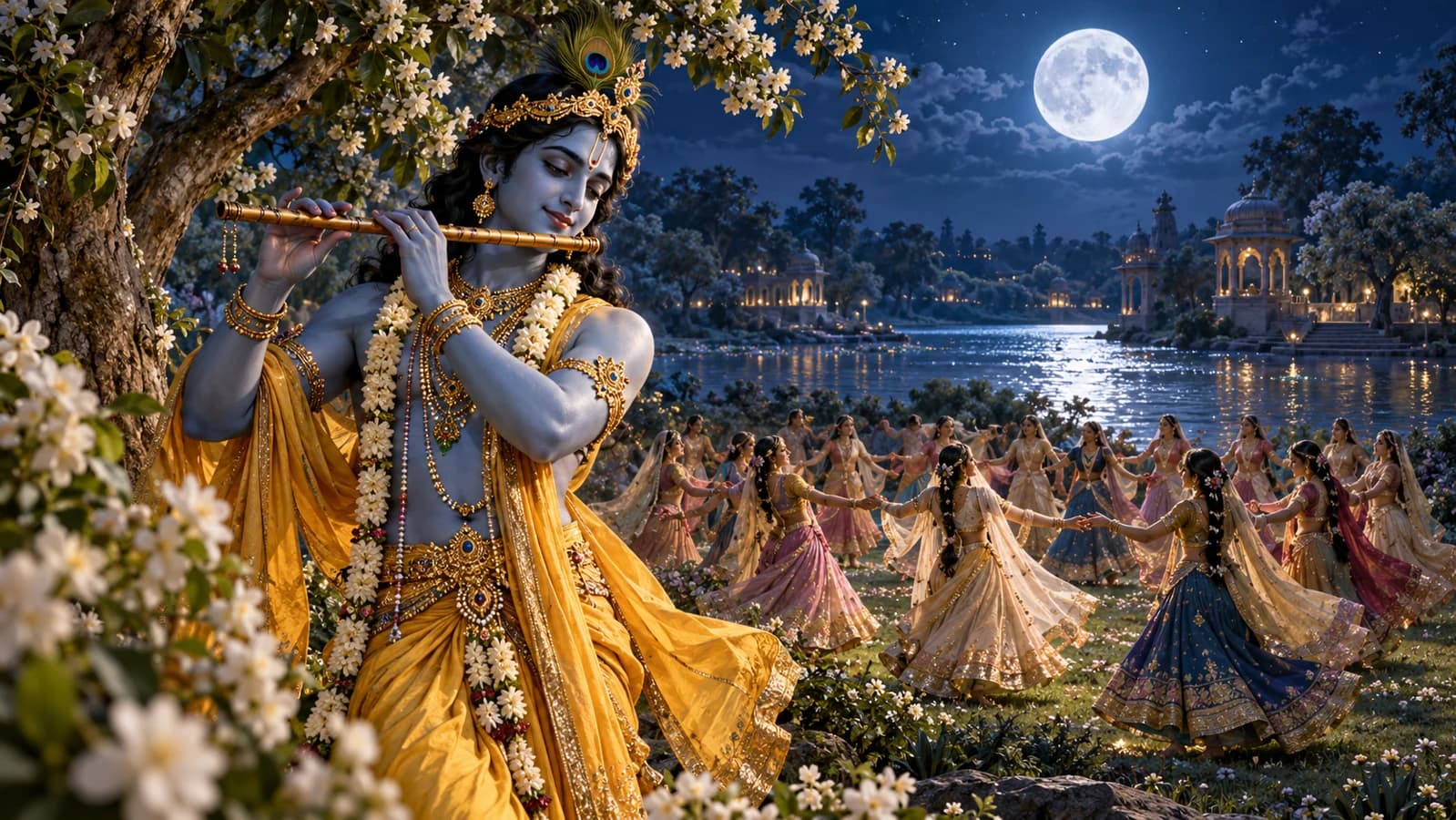
The connection begins with the Bhāgavata’s own landscape: autumn nights, flowering jasmine and the rising full moon. In 10.29.1–3, Sri Krishna looks upon the moonlit forest and plays his flute. The gopīs hear it and come to him. The season is part of the story’s atmosphere from its opening words.
Braj and other Vaishnava traditions remember this autumn līlā on Sharad Purnima. The scriptural setting and the festival observance belong together, while remaining distinct kinds of evidence: the passage describes an autumn full moon; the living tradition gives that night a place in the worship calendar.
For readers planning this year’s observance, Sharad Purnima falls on Sunday, 25 October 2026 in the Indian calendar checked. Use the Sharad Purnima guide for the festival overview and your local panchang for timings. Here, we follow the Krishna story behind the moonlit image.
What does Rasa Lila mean?
Rāsa refers here to the circular dance; līlā means divine play. Rasa Lila, also written Ras Leela, names Krishna’s sacred play with the gopīs, the cowherd women of Vraja. In the Bhāgavata, their relationship is expressed through the intense language of love and longing.
The related Sanskrit word rasa can mean flavour, essence or an experience deeply relished. Devotional writers draw on that richness when explaining Krishna bhakti. It helps to distinguish the name of the dance from the wider spiritual and aesthetic meanings associated with it.
In “Rasa Krida,” published in Śṛṅgeri’s Tattvaloka, S. S. N. reads the episode through divine bliss, Yogamāyā and love that expects no reward. This is a traditional interpretive guide: the visible circle of dancers points toward an encounter with Bhagavan that cannot be reduced to ordinary entertainment.
Where is the complete Rasa Lila story in scripture?
The principal account followed here is Bhāgavata Purāṇa, Book 10, chapters 29–33. Together these five chapters are commonly called the Rāsa Pañcādhyāyī, the five chapters of the rāsa. Śukadeva narrates them to King Parīkṣit.
Read all five in sequence. Beginning with the dance alone leaves out the searching, prayer and conversation that give it emotional and devotional depth.
| Chapter | What happens | What to notice |
|---|---|---|
| 10.29 | The flute calls the gopīs; Krishna speaks with them and later disappears. | The autumn setting, Yogamāyā and the movement from honour toward humility. |
| 10.30 | The gopīs search the forest and follow footprints. | Remembrance fills the landscape; an especially beloved gopī enters the account. |
| 10.31 | The gopīs sing the Gopī Gīta. | Their longing becomes shared prayer. |
| 10.32 | Krishna returns and speaks with them about love. | His acknowledgment of a devotion he cannot repay. |
| 10.33 | The circular dance unfolds. | Divine presence, the caution against imitation and the fruit of reverent hearing. |
Why does Krishna play the flute?
Within the story, the flute draws the gopīs to Krishna. Bhāgavata 10.29.3 places its sound in a forest brightened by the full moon. The following verses show women absorbed in ordinary work suddenly turning toward him. The call reaches them in the middle of life.
For devotional reflection, this is the difference between hearing a beautiful sound and recognising the one who calls. The gopīs respond because their attention is already bound to Krishna. The flute makes that inward attachment audible.
A reader can hold the image gently: what do I make room to hear when work, worry and habit fill the day? That question is our reflection on the episode, rather than a literal translation of its verses. It offers a practical doorway into remembrance without turning the story into a rule that everyone must abandon their responsibilities.
Why does Krishna disappear before the dance?
Bhāgavata 10.29.47–48 connects Krishna’s disappearance with the gopīs’ sense of exceptional good fortune and the quieting of pride. Verse 48 also uses prasādāya, pointing toward grace or favour. The narrative asks us to read this withdrawal within divine care.
Later, in 10.32.20, Krishna explains that an apparent delay in responding can deepen the devotee’s absorption in him. The Bhaktivedanta commentary presents this through a specifically Vaishnava understanding of separation intensifying prema, divine love.
For the reader, the searching chapters slow the story down. The sweetness of closeness has been tasted; now remembrance must continue without the same visible reassurance. The gopīs call to trees and creepers, recall Krishna’s deeds, and search together. The forest becomes a place filled with remembered presence.
This is sacred narrative about Krishna and his devotees. Its value for reflection lies in the perseverance of remembrance; it should be approached with the tenderness the gopīs’ devotion deserves.
What is the Gopī Gīta, and why should you read it?
The Gopī Gīta is the nineteen-verse song in Bhāgavata 10.31. Having searched for Krishna, the gopīs turn to singing. They recall his protection, his smile, his feet moving through the forest, and the joy and pain of loving him.
Verse 10.31.4 addresses Krishna as the witness dwelling within all embodied beings. This matters: their beloved is also the indwelling Lord. The song moves naturally between intimate affection and recognition of his divine nature.
One especially memorable opening is “तव कथामृतं तप्तजीवनं” — tava kathāmṛtaṁ tapta-jīvanam (10.31.9). In a brief rendering of its sense: your words and stories are nectar, life for those scorched by sorrow. The verse goes on to honour those who share that sacred narration.
If you have time for only one chapter on Sharad Purnima, this is a meaningful place to begin. Read a trustworthy translation slowly. Notice what the singers remember about Krishna before trying to explain every poetic image. Their prayer grows from relationship.
Where is Rādhā in the Rasa Lila account?
Krishna traditions honour Rādhā as central to the līlā. In the Sanskrit narrative of these chapters, however, the especially favoured gopī is not explicitly introduced by the proper name Rādhā. Chapter 30 describes the other gopīs discovering her footprints beside Krishna’s.
At 10.30.28 they say, “अनयाराधितो नूनं” — anayārādhito nūnam: surely he has been worshipped by this one. In the Gaudiya Vaishnava commentary presented on VedaBase, Viśvanātha Cakravartī draws attention to ārādhitaḥ and recognises Rādhārāṇī in that expression.
The distinction helps a reader use different books well. A translation may present the unnamed gopī; a commentary or devotional retelling may name her Rādhā and unfold her significance. The latter is conveying a received interpretation. Understanding that relationship lets us respect the tradition while reading the wording carefully.
What does Krishna say when he returns?
Krishna’s return leads to a conversation about love before the great dance begins. In chapter 32, the gopīs ask about people who return affection, people who give it without receiving it, and people who appear not to respond. Their question gives voice to what separation has made them feel.
The chapter reaches an extraordinary acknowledgment in 10.32.22. Krishna says that he cannot adequately repay their faultless devotion, even over a divine lifetime. The Lord receives their love as something beyond ordinary repayment.
That is a useful verse to carry away from the entire story. Prayer can easily become an account book of offerings and expected results. Here, love has reached a different freedom. Its worth does not depend on securing a proportionate reward.
This also clarifies the Tattvaloka article’s emphasis on love without a bargain. The devotional movement is toward an offering of oneself, with Krishna acknowledging the depth of that offering.
Why is Krishna beside every gopī in the circle?
Bhāgavata 10.33.2–3 describes the gopīs forming a circle, with Krishna entering between them through his divine power. Each experiences his nearness. The familiar artistic image of many Krishnas within one dancing circle comes from this extraordinary moment.
The Tattvaloka explanation treats that multiplication as a sign that the episode belongs to a divine plane. The chapter itself uses the image of a child playing with its own reflection at 10.33.16, giving another way to contemplate a unity expressed through many forms.
As devotional reflection, the circle offers a generous image: another devotee’s closeness need not diminish one’s own. The scene invites us to contemplate a divine presence that is intimate without being exhausted by a single relationship. This is an interpretive meaning of the image, rather than an additional event in the story.
How does the Bhāgavata ask us to receive this līlā?
The ending gives clear guidance. In 10.33.30, Śukadeva cautions against imitating divine acts, using the example of Rudra drinking the ocean-born poison. Readers familiar with the story of Shiva as Nīlakaṇṭha will recognise the comparison.
The concluding verse, 10.33.39, turns toward hearing and recounting the līlā with śraddhā, reverent faith. Its stated fruit is deep bhakti and the overcoming of kāma, the binding desire described metaphorically as a disease of the heart. The direction of the teaching is spiritual transformation.
This conclusion belongs beside the moon, flute and dancing figures whenever we explain the story. It helps a newcomer see what the narrator wants the encounter to cultivate: a heart increasingly capable of devotion.
A simple way to spend time with the story this Sharad Purnima
You do not need to master every commentary in one evening. Begin with a manageable reading and let it become attentive rather than hurried. The following is an editorial suggestion for study and listening, not a prescribed vrata or ritual.
- Read Bhāgavata 10.29.1–3 for the autumn moon and the flute’s call. Picture the setting before moving on.
- Read or listen to the Gopī Gīta, chapter 31, with a translation. Choose one verse to revisit instead of rushing through many recordings.
- Read 10.32.22 and 10.33.39 together: the first honours the gopīs’ devotion; the second tells the listener what reverent hearing can nurture.
- Allow a few quiet minutes afterward. If music helps you remain attentive, continue with RudraNāda’s Krishna flute meditation, linked below, remembering that it is an artistic companion to study.
What can we carry from the moonlit circle?
The full moon gives the līlā its light; the gopīs give it their attention. Their story moves through the joy of hearing, the difficulty of searching, the honesty of prayer and the gladness of reunion. Reading the whole sequence lets each of those movements remain visible.
For RudraNāda, this is also a reminder of what devotional music can make possible. A song can draw us toward a story; the story can lead us toward a verse; the verse can stay with us after the sound has ended. Return to the Krishna hub to explore his other forms, from the flute-bearing Lord of Vraja to the teacher of the Bhagavad Gita.