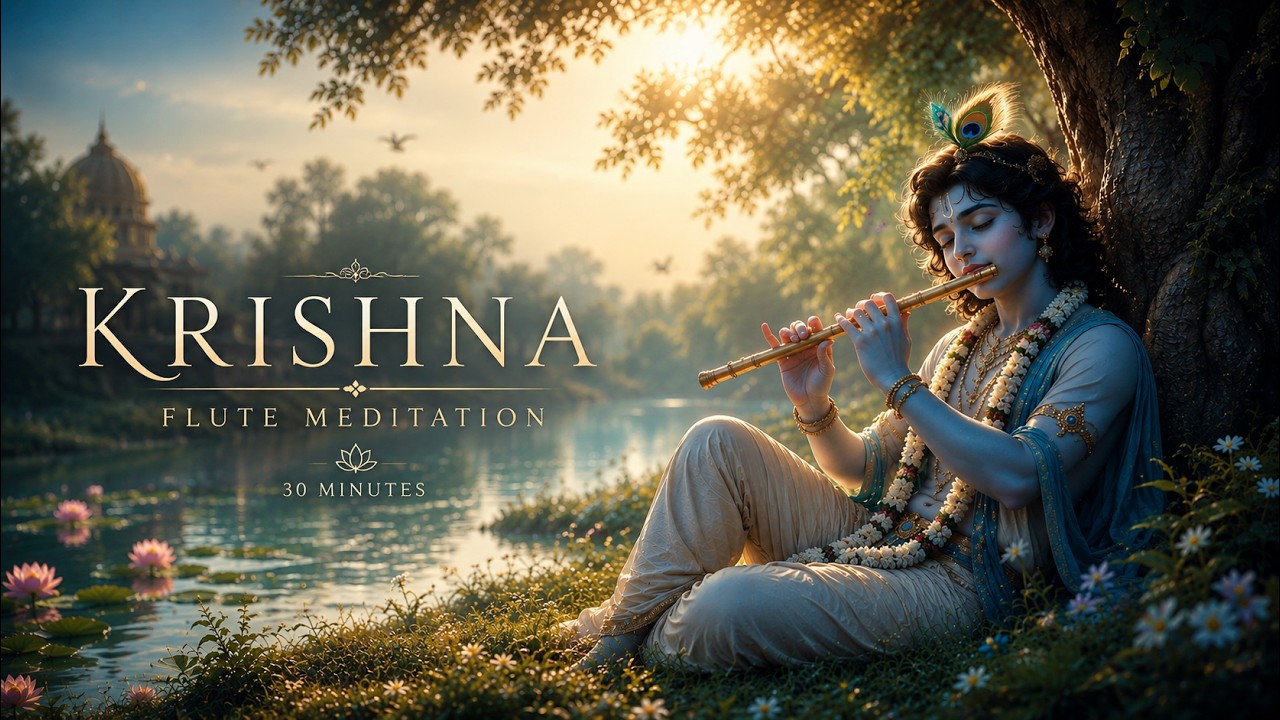
The moment before Krishna speaks
At the beginning of the Bhagavad Gita, the armies are already assembled at Kurukshetra. Arjuna asks Krishna to place the chariot between them. When he sees relatives, elders, teachers and friends on both sides, grief overwhelms him. His body trembles, his mind reels and the Gandiva bow slips from his hand.
That is the dramatic point from which Uth Parth begins. The song compresses a long philosophical dialogue into a cinematic arc: despair, Krishna’s teaching on the self, action without attachment, the universal form, and finally the command to rise.
The song should therefore be heard as an interpretation inspired by the Gita, not as a substitute for the text. Some lyric lines closely echo particular verses; others combine themes from several chapters or use new poetic imagery.
The lyrics
The words as they appear in RudraNāda’s original composition.
Intro
Kurukshetra ro raha tha…Dharti kaanp rahi thi…Aur us yudh ke madhya mein…Ek saarathi muskura raha tha…
Verse 1
Rath ke pahiye thahar gayeTeer zameen ko chhoo gayeArjun ki aankhon mein andheraApne bhi lagne lage paraayeHaath kaanpe, hriday tootaVeerata bhi dar gayiTab Madhav ne dheere se kaha“Tu sharir nahi, tu aatma hai Parth…”
Pre-Chorus
Jab dharam andhere mein kho jaayeJab mann bhay se ghir jaayeTab bansuri waala aata haiMuskura ke sach dikhaata hai…
Chorus
Govind bolo! Hari Gopal bolo!Ran mein khada hai KanhaiyaChakra ghoomta, kaal bhi jhuktaGeeta ki jyoti jagati reNa tu marta, na tu maaregaAtma amar, sadaa re…Govind bolo! Hari Gopal bolo!
Verse 2
Karm kar, phal ki chinta chhod deAgni mein jala de saari vyathaJo aaya hai, woh jaayegaSaty hi shesh rahegaSuraj bhi ruk gaya sunne koDevta jhuk gaye charnon meinEk saarathi ke mukh se niklaBrahmand ka sabse gehra raaz…
Bridge
Vishwaroop jab aankhon mein chhayaArjun ka rom-rom kaanp uthaSau soorya ek saath chamkeKaal swayam charnon mein aayaKrishna bole, awaaz ghan ghor:“Uth Parth! Yudh abhi baaki hai…Moh ko chhod, dharm ko sambhaal…”
Final Chorus
Govind bolo! Hari Gopal bolo!Shankh baaje Kurukshetra meinDarr ko jala, moh ko mitaNaam le Vasudev ka reHare Krishna Hare KrishnaKrishna Krishna Hare HareGeeta ka gyaan amar rahegaDharti se aakash tak…
Outro
Yada yada hi dharmasya…Glānir bhavati bhārata…Abhyutthānam adharmasya…Hare Krishna… Hare Krishna…
What the song is saying
The battlefield is also an inner crisis
The opening does not begin with victory. It begins with paralysis. Arjuna sees people he loves and reveres across the battlefield, and his certainty collapses. The song turns that hesitation into a dramatic stillness before Krishna begins to speak.
You are not reduced to the body
“Tu sharir nahi, tu aatma hai Parth” condenses one of the Gita’s central early teachings: the self is not destroyed when the body is destroyed. The chorus develops that idea with “Na tu marta, na tu maarega.”
Act without being consumed by the result
“Karm kar, phal ki chinta chhod de” points toward karma-yoga. The song is not saying consequences are irrelevant. It dramatizes Krishna’s demand that Arjuna act according to duty without making possession of the result the basis of action.
Vishwaroopa changes the scale of the story
The bridge moves from one warrior’s fear to a cosmic vision. The image of many suns and the appearance of Time are drawn from Chapter 11, where Arjuna sees Krishna’s universal form and confronts a reality much larger than his individual viewpoint.
“Uth Parth” is the pivot
The title means, in spirit, “Rise, Parth.” It captures the movement from collapse to action. The Gita itself addresses Arjuna as Pārtha and tells him to arise after abandoning weakness of heart.
Where the Bhagavad Gita enters the song
These are the verses that sit behind the song’s ideas. A lyrical paraphrase is still labelled as a paraphrase.
Arjuna’s collapse before the battle
Arjuna sees his own kinsmen arrayed for battle, becomes physically overwhelmed and says the Gandiva is slipping from his hand. This is the textual background for the song’s opening stillness.
Read the verse on IIT Kanpur Gita Supersite ↗“Arise, O Partha”
Krishna addresses Arjuna as Pārtha and tells him to cast off weakness of heart and arise. “Uth Parth” is RudraNāda’s compact Hindi dramatic rendering of that turning point.
Read the verse on IIT Kanpur Gita Supersite ↗The self neither slays nor is slain
The chorus line “Na tu marta, na tu maarega” is a lyrical paraphrase of this teaching, not a literal translation of the Sanskrit verse.
Read the verse on IIT Kanpur Gita Supersite ↗Action without attachment to its fruits
This is the clearest textual anchor for “Karm kar, phal ki chinta chhod de.” The verse emphasizes action, non-attachment to results and avoiding attachment to inaction.
Read the verse on IIT Kanpur Gita Supersite ↗When dharma declines
The outro invokes the opening of this verse: “Yadā yadā hi dharmasya…” It is intentionally a partial invocation rather than a presentation of the full shloka.
Read the verse on IIT Kanpur Gita Supersite ↗The radiance of a thousand suns
The bridge’s “Sau soorya ek saath chamke” directly draws on the Gita’s image of a thousand suns blazing simultaneously as a comparison for the radiance of the universal form.
Read the verse on IIT Kanpur Gita Supersite ↗Krishna as Time
The song’s imagery of kāla connects to Krishna’s declaration in the universal-form chapter that he is Time, already engaged in the destruction of the assembled warriors.
Read the verse on IIT Kanpur Gita Supersite ↗Arjuna is ready to act
Near the end of the Gita, Arjuna says his delusion is destroyed, his doubt is gone and he will act. That resolution is the larger arc behind the song’s final rise.
Read the verse on IIT Kanpur Gita Supersite ↗Questions listeners ask
What does “Uth Parth” mean?
“Uth” means “rise” or “get up,” while Pārtha is a name used for Arjuna. In the song, “Uth Parth” is Krishna’s dramatic call for Arjuna to move from paralysis toward action.
Why did Arjuna hesitate to fight at Kurukshetra?
Arjuna saw relatives, teachers, elders and friends on the opposing side and was overcome by grief, compassion and moral confusion. The first chapter of the Bhagavad Gita describes his physical and emotional collapse before Krishna begins his teaching.
Is “Na tu marta, na tu maarega” an exact Bhagavad Gita verse?
No. It is RudraNāda’s Hindi lyrical paraphrase. Its closest direct textual anchor is Bhagavad Gita 2.19, which teaches that the self neither slays nor is slain.
Which Bhagavad Gita verse inspired “Karm kar, phal ki chinta chhod de”?
The strongest connection is Bhagavad Gita 2.47, which teaches action without attachment to the fruits of action and warns against attachment to inaction.
What is Vishwaroopa in Uth Parth?
Vishwaroopa is Krishna’s universal form in Chapter 11 of the Bhagavad Gita. Arjuna is granted divine sight and sees an overwhelming cosmic form containing the worlds, divine beings and the warriors moving toward destruction.
Is Uth Parth a translation of the Bhagavad Gita?
No. It is an original RudraNāda composition inspired by the setting and teachings of the Gita. The page identifies specific verses behind its imagery so listeners can distinguish the scripture from the song’s artistic interpretation.